
On this page
Why gutters sag
| Cause | What you see | Fix |
|---|---|---|
| Spikes backing out | Nail heads sticking out, gutter leaning forward | Replace with screwed hidden hangers |
| Hangers too far apart | Dips between hangers | Add hangers at closer spacing |
| Weight of wet debris | Sag that gets worse through the wet season | Clean, re-hang, consider guards |
| Rotten fascia | Hangers pulling out of soft wood | Replace the fascia, then re-hang |
| Limb or wind damage | Sudden bend, torn hangers | Replace bent sections and hangers |
| Lost pitch | Water standing in the gutter | Re-hang to an even fall |
Why sagging is common in Redmond
Wet, heavy debris. In a dry climate, leaves in a gutter dry out and blow away. Here, where the regional record shows rain on about 156 days a year, needles, moss and leaves stay soaked and compact into a heavy mat. A gutter full of it, plus standing water behind a plugged outlet, is a serious load on its hangers for months at a time.
Old fastening and wet wood. Many 1960s, 1970s and 1980s houses still have gutters hung on spikes and ferrules. Decades of damp weather soften the fascia around each spike, and the spikes back out.
Wind, limbs and snow. Redmond's hazard plan records a 2006 windstorm, a 2018 storm with 45 mph gusts, and nine days of snow totalling more than 20 inches in 2019. After the November 2024 bomb cyclone, Eastside Fire and Rescue answered more than 250 calls about downed trees. A falling limb can bend a gutter and tear out several hangers at once.
How a sagging gutter is fixed
- Clean the run. Debris and water are removed so the gutter can be lifted.
- Check the fascia. The contractor probes the board behind the gutter. Soft wood is cut out and replaced before anything is fastened to it.
- Re-pitch. A string line or level sets a steady fall toward the outlet, often around a quarter inch per 10 feet.
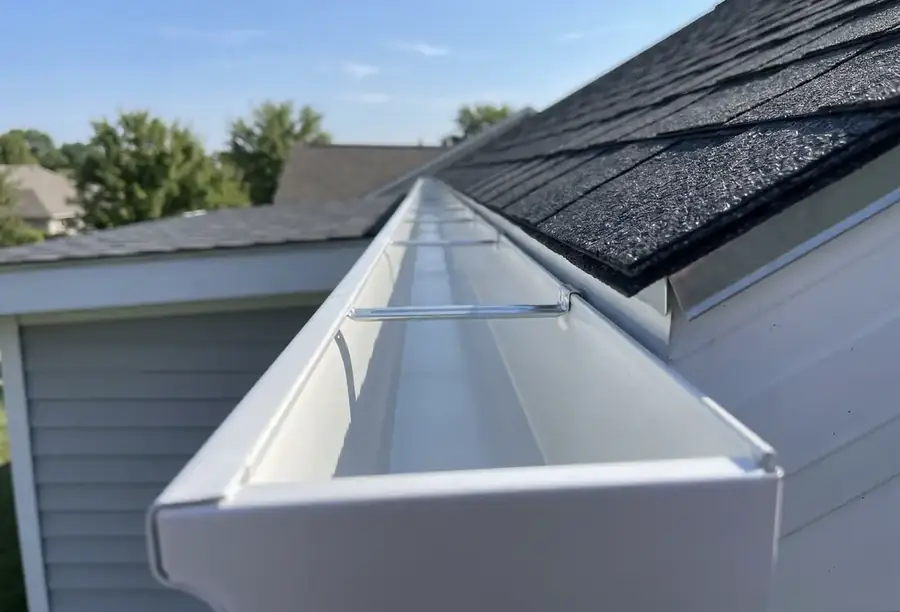
- Fasten with hidden hangers. Screws go through the hanger into solid fascia or rafter tails, usually about every 2 feet, closer under trees.
- Reseal joints that were flexed when the gutter sagged.
- Test. Water runs to the outlet with nothing standing.
A worked example
Here is an illustration of a typical visit. A 1980s house in Cottage Lake has a back gutter that dips in the middle, with water and needles standing after rain. The contractor finds the outlet plugged, five spikes backed out and a short stretch of soft fascia. The outlet is cleared, the board replaced, the run re-pitched and hidden hangers screwed in every two feet. A larger 3x4 outlet is added so needles stop plugging it.
When to replace instead
If several runs sag, the gutters are old sectional steel, or the fascia is rotten along most of the house, gutter replacement usually makes more sense. The old gutters come down, the wood is repaired along the whole eave, and new seamless gutters go up on new hangers.
Cost
Rehanging a run is usually a moderate repair. Angi puts the national average for gutter repair at about $390, but the range is wide: a short run rehung on new hangers costs less, while a long second-storey run with fascia replacement costs more. National figures only.
Keeping it from happening again
- Clean the gutters before the wet season and again during it under conifers.
- Fit gutter guards if needles and moss are the problem.
- Make sure outlets and downspouts are clear, so water does not stand in the gutter.
- Ask for hidden hangers at close spacing, screwed into solid wood.
Why sagging gets worse in winter
Wet needles, moss and standing water are heavy, and in Redmond's wet season gutters rarely dry out. A run that sags slightly in summer can pull loose by midwinter. Each sag also traps more water, adding weight where the hangers are already failing. Fixing a sag in the dry season, before the rains, is cheaper than fixing a torn-off gutter after a storm.